The Ultimate Guide to the 2026 Digital SAT
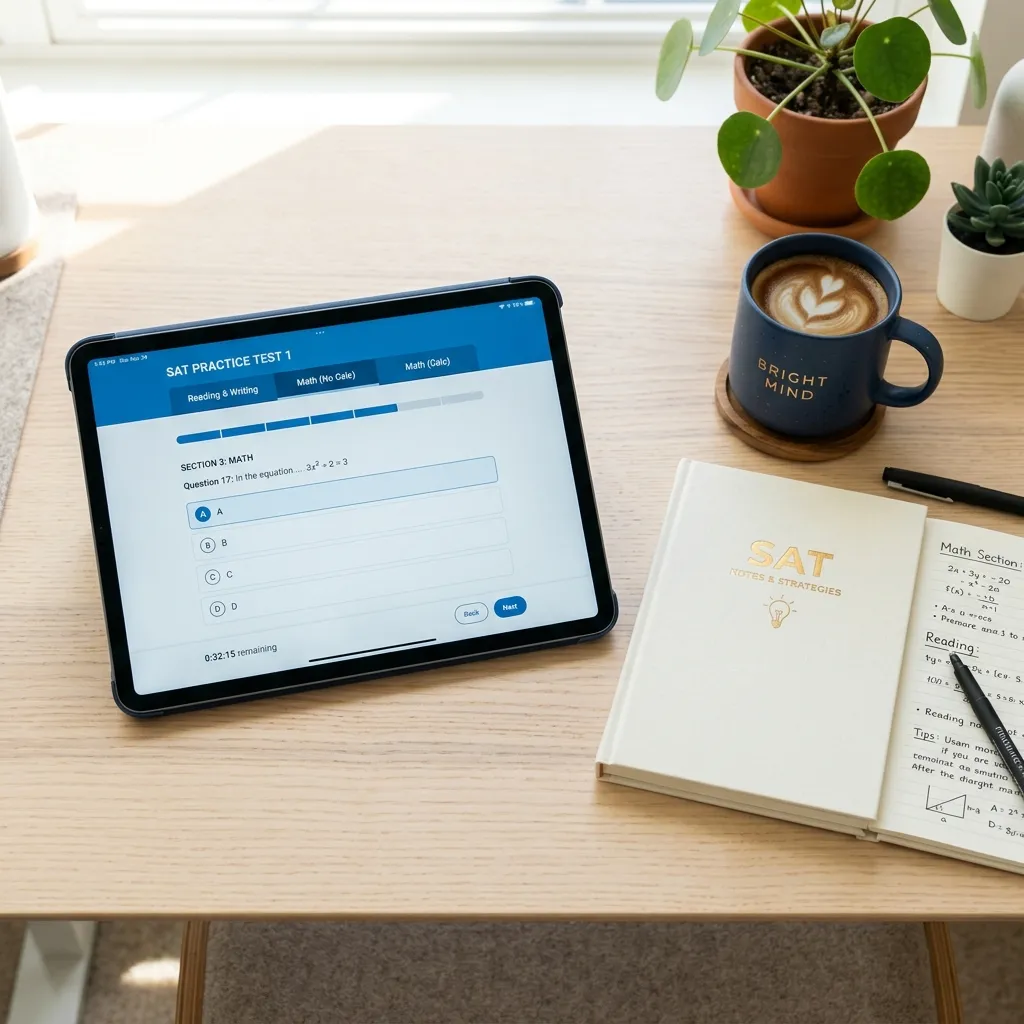
If you're taking the SAT in 2026, you're taking the Digital SAT. The paper test is gone forever. With the transition to digital, the College Board completely changed the format, timing, and scoring mechanics of the exam.
This comprehensive guide breaks down everything you need to know to navigate the 2026 Digital SAT. Whether you are aiming for a 1200 or a perfect 1600, understanding the mechanics of the test is the first step to conquering it.
1. The Multistage Adaptive Format Explained
You cannot effectively prepare for the Digital SAT if you don't understand how it adapts. The test is broken into two sections: Reading & Writing (R&W) and Math. Each section is split into two "modules."
The first module in each subject acts as your baseline. It contains a mix of easy, medium, and hard questions. How you perform in Module 1 determines the exact difficulty of Module 2.
- The High-Scoring Path (Hard Module 2): If you score above the median in Module 1, you get routed to the hard Module 2. The questions will be noticeably more difficult, but this path unlocks the highest possible scores (up to 800 per section).
- The Capped Path (Easy Module 2): If you drop too many points in Module 1, you get routed to the easy Module 2. The questions will feel more comfortable, but your score potential is strictly capped—usually around 600–650 per section—no matter how perfectly you perform on the second module.
The Strategic Takeaway: Early accuracy is everything. You cannot afford to make careless mistakes on the easy questions in Module 1, because unlocking the hard module is a prerequisite for a top-tier score.
2. Deep Dive: Reading & Writing (R&W)
The old SAT forced students to read sprawling, 90-line passages with 10–11 questions attached to each. The 2026 Digital SAT does the exact opposite: every single question is now paired with its own short text (usually 25–150 words).
Instead of reading for overarching themes across pages of text, you are now evaluating short, dense paragraphs. The questions are grouped by "domains," meaning you'll jump quickly between grammar, vocabulary, reading comprehension, and logical transitions.
The Four R&W Domains:
- Information and Ideas: Testing your ability to locate, interpret, and evaluate information. Expect questions asking for the "main idea" or requiring you to synthesize data from a chart.
- Craft and Structure: Testing vocabulary in context and the purpose of the text. (e.g., "Which word most logically completes the text?")
- Expression of Ideas: Testing rhetorical transitions. (e.g., Should you use "However," "Therefore," or "Furthermore" to connect these sentences?)
- Standard English Conventions: Pure grammar. Testing sentence boundaries, punctuation, and subject-verb agreement.
Key R&W Strategy:
Read the question before the passage. Because the passages are so short and varied, knowing what you're looking for before you start reading saves massive amounts of time. Furthermore, lock down your grammar rules. Conventions questions test established rules (semicolons, colons, modifier placement). These are the most learnable, objective points on the exam.
3. Deep Dive: Math & The Desmos Advantage
The Math section is 44 questions across two modules (70 minutes total). The concepts tested haven't changed drastically—you still need a strong foundation in Algebra, Advanced Math, Problem-Solving and Data Analysis, and Geometry/Trigonometry—but how you attack them has completely shifted.
The Secret Weapon: Built-In Desmos
For the entire Math section, you have access to a built-in Desmos graphing calculator directly within the testing app. If you are not using it to its full potential, you are leaving points on the board.
Desmos isn't just for visualizing lines. It is a powerful algebraic tool that can:
- Solve equations instantly: Type in an equation, and Desmos highlights the intersection/solution.
- Find vertices without mental math: Click the peak or valley of a parabola on the graph to instantly reveal the vertex coordinates.
- Handle complex systems: Graph two equations and find where they overlap, entirely bypassing substitution or elimination methods.
Our data at Praczo shows that students who master Desmos shave an average of 45–60 seconds off every medium-to-hard algebra question. This is the ultimate tool for preserving your time in Module 2.
4. Scoring, Superscoring & Benchmarks
The SAT is still scored on a 400–1600 scale. However, because the test is adaptive, two students who answer the exact same number of questions correctly might receive different scores if they were routed to different Module 2s.
Superscoring is your best friend. Most colleges "superscore" the SAT. This means they will take your highest Math score from one test date and combine it with your highest Reading & Writing score from another test date to create an "ultimate" superscore. Because of this, planning to take the SAT at least twice is highly recommended.
What is a "good" score? It depends entirely on your college goals:
- 1200+: Puts you comfortably above the national average; competitive for many state universities.
- 1350+: Competitive for flagship state universities and many private colleges.
- 1500+: The benchmark for top-tier, highly selective schools (Ivy League, Stanford, MIT).
5. Pacing and Time Management Framework
Time management remains the #1 killer of good scores, especially when you hit the hard Module 2.
Module 1 pacing should feel relatively brisk. You want to secure the easy points quickly. But when you hit the hard Module 2, the clock will feel like it's moving twice as fast because every question requires more cognitive load.
The "Flag and Move On" Rule: The testing interface has a built-in "mark for review" feature. If a question stumps you for more than 90 seconds, flag it, guess, and move on. Secure the points you know you can get first, build your confidence, and return to the flagged, time-consuming questions at the end.
6. Test Day Logistics & The Bluebook App
You cannot take the Digital SAT on a web browser. You must download the College Board's official app called Bluebook onto an approved Windows laptop, Mac laptop, iPad, or school-managed Chromebook.
What to Bring on Test Day:
- Your fully charged device with the Bluebook app installed.
- Your admission ticket (which you access inside Bluebook) and an acceptable photo ID.
- A power cord and portable charger. (Keep in mind: test centers cannot guarantee access to an outlet).
- Pencils or pens for scratch work (the test center will provide physical scratch paper).
- A handheld calculator, if you prefer it as a backup to Desmos.
Because the test is digital and downloaded locally to your machine before you start, you will not lose time or progress if the Wi-Fi temporarily drops in the test center.
7. Building Your 2026 Study Plan
A generic study plan of "I'll do 20 math questions a day" won't cut it. The Digital SAT tests roughly 183 distinct concepts. To improve efficiently, you need to know exactly which ones are bringing your score down.
- The Diagnostic Phase: Take a full-length adaptive practice test under strict testing conditions. Get your baseline score.
- The Concept Trench: Don't just look at the score. Figure out exactly why you lost points. Was it "Factoring Quadratics" or "Transitions"? Spend the bulk of your prep time ruthlessly drilling the 10–15 concepts you consistently get wrong.
- The Simulation Phase: As test day approaches, stop worrying about learning new concepts. Focus entirely on taking simulated exams to perfect your pacing and adapt to the intensity of the hard Module 2.
At Praczo, we automate this entire process for you. Our platform acts as your personal AI tutor, mapping your weaknesses down to the specific concept and feeding you targeted practice questions to close those gaps fast.
Final Thoughts
The transition to the Digital SAT is an immense advantage if you prepare correctly. Focus on flawless execution in Module 1, treat Desmos like a primary weapon, and stop wasting time studying concepts you already know. Target your weak spots ruthlessly with practice that adapts to you, and your goal score is entirely within reach.
See exactly where your SAT score is leaking.
Praczo tracks your performance at the concept level — 183 skills, pinpointed.
Start free trial — 3 days free